Made & Hosted in Germany
By Claudia Feltkamp, Co-Founder & Managing Partner of Claysoft GmbH and former hotel manager | Last updated: September 2026
In a nutshell: An HACCP plan is an in-house system that food businesses use to identify health hazards, control them at critical control points, and document these controls. It is mandatory for all food business operators in the EU (Regulation (EC) No. 852/2004, Article 5). Temperature control is one of the most important critical control points in nearly every food business. Automated temperature monitoring makes this control more reliable and is recognized by food safety authorities provided that the records are complete, tamper-proof, and accessible at any time.
What is an HACCP plan?
An HACCP plan is a preventive self-monitoring system for food safety. HACCP stands for “Hazard Analysis and Critical Control Points.”
The plan describes where biological, chemical, or physical hazards to food can arise within the operation, how these points are monitored, and what happens in the event of deviations. The goal is not to find errors after the fact, but to prevent them from occurring in the first place.
Who needs an HACCP plan?
Any business that produces, processes, stores, transports, or distributes food needs an HACCP plan. This applies to restaurants, hotels, cafeterias, caterers, bakeries, butcher shops, care facilities, hospitals with their own kitchens, and food retailers.
Only primary production (such as agriculture) is exempt from the HACCP principles. The size of the business does not matter; however, the plan may be simpler for small businesses.
Is an HACCP plan required by law?
Yes. This requirement stems from Article 5 of Regulation (EC) No. 852/2004 on food hygiene. In Germany, the Food Hygiene Regulation (LMHV) supplements these requirements. Responsibility always lies with the food business operator, that is, the operator themselves.
What are the 7 principles of HACCP?
The seven HACCP principles are internationally defined in the Codex Alimentarius and form the framework of every HACCP plan:
- Conduct a hazard analysis: What hazards can occur at each step of the process?
- Identify critical control points (CCPs): At which points must a hazard be controlled?
- Establish limit values: For example, a maximum storage temperature or a minimum core temperature.
- Establish monitoring procedures: Who measures what, how, and how often?
- Establish corrective actions: What happens if a limit is exceeded?
- Verification: Regularly check whether the system is working.
- Documentation: Record all measurements, deviations, and actions in writing or digitally.
What is a critical control point (CCP)?
A critical control point is a step in the process where a hazard must be prevented, eliminated, or reduced to an acceptable level because there is no further opportunity for control afterward. Typical CCPs in the food service industry include cooking food thoroughly, holding food hot, cooling food, and cold storage.
What temperatures are important in the HACCP program?
Temperature is the most common critical control point because bacteria multiply rapidly at the wrong temperature. The following values serve as a general guideline. The manufacturer’s specifications, applicable legal regulations, and the guidelines for good hygiene practices in the respective industry are decisive.
| Range | Typical Limits |
|---|---|
| Cold Storage in General | max. +7 °C |
| Fresh meat | max. +4 °C (ground meat max. +2 °C) |
| Fresh Fish | 0 to +2 °C |
| Frozen foods | -18 °C or colder |
| Keeping Food Warm | at least +65 °C |
| Heat thoroughly (core temperature) | at least +72 °C for 2 minutes |
How often must the temperature be checked and recorded?
There is no fixed legal frequency. The business determines this itself in its HACCP plan, and the frequency must be chosen so that deviations are detected in a timely manner. In practice, refrigerators and freezers are usually checked once or twice a day when monitored manually.
The problem with this is that there are often many hours between two manual measurements. If a refrigerator fails at night or on the weekend, no one will notice until the food has already spoiled.
Is automatic temperature monitoring permitted, and is it recognized by the authorities?
Yes. The EU Hygiene Regulation does not specify the form in which monitoring and documentation must be carried out. Automated, digital records are accepted by food safety authorities if they meet three requirements:
- They are complete, meaning there are no gaps in the measurement sequence.
- They cannot be altered retroactively.
- They can be presented to food inspection authorities at any time.
An additional quality feature is the conformity of the measurement technology with the DIN EN 12830 standard, which specifies requirements for temperature recording devices used in the storage and transport of food.
TEMPASCAN, for example, is a proven and legally compliant solution.
Why is automatic temperature monitoring safer than manual measurement?
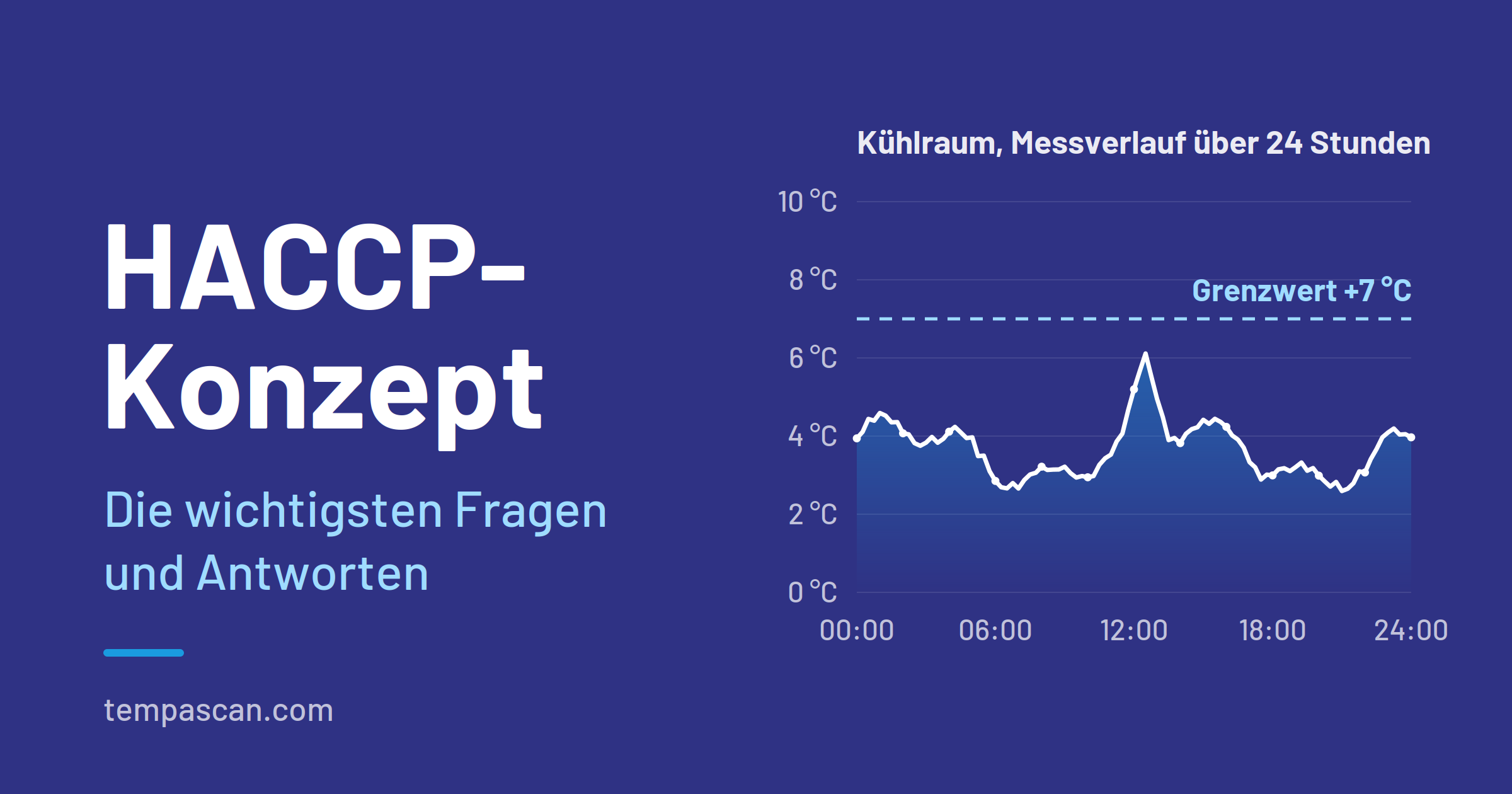
Automated systems take measurements around the clock at frequent intervals, rather than just once or twice a day. This allows deviations to be detected immediately, even at night, on weekends, and on holidays. If a limit is exceeded, staff are alerted immediately—for example, via an app, text message, or email—and can take action before the goods spoil.
Additional advantages over paper lists:
- No missed measurements, even during staff shortages or shift changes.
- No reading or transcription errors.
- No lists filled out retroactively, which would stand out during an inspection and call into question the credibility of the entire system.
- Less time spent on work, since there’s no need to take readings or record them.
How much does automatic temperature monitoring cost?
What does the food inspection agency check when reviewing the HACCP plan?
Food safety inspectors verify whether an HACCP plan is in place and whether it is actually being implemented on a day-to-day basis. Typically, inspectors review:
- the written hazard analysis and the established CCPs,
- the temperature records from the past weeks or months,
- the documented corrective actions taken in response to deviations,
- cleaning and disinfection plans,
- evidence of staff hygiene training.
The situation becomes particularly critical when records are missing, incomplete, or have clearly been filled in retroactively.
What happens if a business has no HACCP plan or an inadequate one?
If the plan is missing or not implemented, the authorities may impose requirements, levy fines, and, in extreme cases, temporarily close the business. If a foodborne illness occurs among guests, there is also the risk of civil and criminal consequences, as well as significant damage to the business’s reputation.
What documents are part of an HACCP plan?
A complete HACCP plan typically includes:
- A description of the business and its products or food items,
- A hazard analysis and overview of the CCPs with critical limits,
- Temperature logs for receiving, storage, cooking, holding, and cooling,
- Cleaning and disinfection plans,
- Pest control records,
- Corrective action records,
- Staff training records.
It is up to the business to decide whether these documents are maintained in paper or digital form. Digital checklists have the advantage of being centrally stored, searchable, and consistent across multiple locations.
Does the HACCP plan need to be reviewed regularly?
Yes. The plan must be updated as soon as anything changes in the business—for example, new menu items, new equipment, new suppliers, or changes to procedures. Regardless, it is recommended to review the plan at least once a year.
What is the difference between HACCP, IFS, and FSSC 22000?
HACCP is a legal requirement for all food businesses. IFS Food and FSSC 22000, on the other hand, are voluntary, internationally recognized certification standards used primarily by manufacturers and suppliers to the retail sector. Both are based on HACCP but go well beyond it and are verified through external audits. Detailed information can be found in the following article.
Note: This article is for general informational purposes only and does not constitute legal advice. The applicable legal regulations and the requirements of the relevant food safety authorities are binding.
Further information on the Codex Alimentarius (international food standards): here.